

At the office of Morris Center for Dentistry, our first goal is to preserve natural teeth whenever it is safe and practical to do so. However, there are times when extraction is the most responsible path to protect a patient's overall oral health. Removing a tooth can stop the spread of infection, prevent damage to neighboring teeth, and pave the way for a healthier, more stable mouth.
We approach every extraction with careful planning and clear communication. Before recommending removal, our team performs a thorough clinical evaluation and reviews any necessary imaging so that you understand why extraction is being suggested and what the anticipated outcome will be. We will discuss alternatives when they exist and explain how extraction fits into your broader treatment plan.
When the decision to extract is made, comfort and safety are our priorities. Our team will explain the chosen technique, anesthesia options, and what to expect during recovery so you can feel confident about the care you receive. Clear instructions before and after the procedure help promote predictable healing and the best possible result.
Persistent baby teeth that block normal development
Sometimes a deciduous (baby) tooth does not loosen and fall out as the adult tooth beneath it tries to emerge. When the baby tooth's root fails to resorb or the tooth becomes fused to the jawbone, it can hinder proper alignment and eruption of the permanent tooth. Removing an over-retained baby tooth can promote normal development and reduce the need for more invasive treatments later.
Severe decay where restoration is not possible
Tooth decay begins on the surface and can progress into the deeper layers of the tooth if left untreated. When structural loss is too extensive for a filling or crown to restore function and protect the root, extraction may be the safest option to prevent ongoing infection and pain.
Teeth that are badly broken or cracked
Fractures that extend below the gumline or into the root can make a tooth non-restorable. In those cases, attempting to preserve the tooth can lead to repeated problems. Careful assessment determines whether repair is possible or whether extraction will result in a more predictable, long-term outcome.
Advanced periodontal disease undermining support
When gum disease progresses unchecked, the bone and soft tissues that hold teeth in place can be lost. Teeth that have become loose as a result of advanced periodontitis may need to be removed to stop disease progression and to allow surrounding teeth to stabilize and heal.
Impacted or problematic wisdom teeth
Third molars commonly lack space to erupt cleanly and can become impacted, infected, or rapidly decayed. Removing poorly positioned wisdom teeth can prevent damage to adjacent molars, recurrent infections, and other complications that affect bite and comfort.
Extractions to relieve crowding before orthodontics
When the jaw cannot accommodate all permanent teeth, selective removal of one or more teeth is sometimes part of an orthodontic plan to create room for alignment and to achieve a functional, stable bite. Extractions in this context are carefully coordinated with the orthodontic team.

Before any extraction, we gather a complete medical and dental history and review any medications or conditions that could affect treatment. Certain health conditions or prescriptions may require adjustments or additional precautions; in some cases, we consult with a patient's physician to ensure a coordinated approach to care. Your safety is the foundation of every treatment decision.
Diagnostic imaging is an important part of planning. Digital radiographs give us a clear view of root shape, bone levels, and the position of nearby anatomical structures. This information helps determine whether a simple removal will suffice or whether a surgical approach will be required. We explain what we see and why a particular technique is recommended so you can make an informed choice.
We also discuss anesthesia and comfort measures up front. Most extractions are completed under local anesthesia, and for patients who experience dental anxiety or require more extensive work, we offer appropriate sedation options. Our goal is to create a calm, pain-controlled experience from the moment you arrive until you are ready to go home.
At your appointment we will examine the tooth, take the necessary images, and outline the steps of the procedure and recovery. You will receive clear pre-procedure instructions—such as fasting requirements if sedation is planned—and information about medications you should or should not take beforehand. This preparation helps reduce risk and makes the day of treatment more predictable for everyone involved.
Extractions are commonly categorized as simple or surgical based on how the tooth sits and its root anatomy. A simple extraction is performed when the tooth is visible in the mouth and can be removed with forceps following administration of local anesthesia. The process is straightforward: the tooth is loosened and extracted with minimal disturbance to the surrounding bone and tissue.
Surgical extractions are used for teeth that are broken under the gumline, impacted, or have complex root shapes. These procedures may involve a small incision to gain access and may require removal of a small amount of bone. Surgical extractions can be performed in our office or, for especially complex cases, in collaboration with an oral and maxillofacial surgeon.
Throughout both types of procedures we focus on gentle technique and patient comfort. After numbing the area thoroughly, we proceed efficiently and with attention to minimizing trauma. If stitches are needed, we will explain whether they are dissolvable or require removal and schedule any necessary follow-up to monitor healing.
We offer a range of options to help patients remain relaxed and comfortable, from calming communication and local anesthesia to conscious sedation when appropriate. Pain control is addressed proactively—your provider will recommend an approach tailored to the extent of the procedure and your personal medical profile so that both the operation and the initial recovery period are as manageable as possible.

Healing after an extraction follows a predictable course when the proper steps are taken. Immediately after the procedure a blood clot forms over the socket, which is an important part of the body's natural repair process. Protecting that clot in the first 24–48 hours helps reduce complications and supports comfortable healing.
We provide tailored post-operative instructions that explain activity limitations, oral hygiene, and what signs to monitor during the first few days. Most patients do well with rest, a soft-food diet for a short period, and gentle oral care. Swelling and mild discomfort are normal and typically resolve within several days with appropriate self-care and medication as recommended.
We also make plans for follow-up when needed—this ensures any sutures are evaluated, infection is ruled out, and your recovery is progressing as expected. If a tooth was removed with the intention of future replacement, we will review the timeline and next steps for restoring function and appearance.
Use gauze to control bleeding
A gauze pad is provided for you to bite on immediately after the extraction. Gentle, consistent pressure helps the socket clot. If bleeding continues beyond the initial period, we will advise on additional steps to control it.
Protect numb tissues
Avoid chewing or touching the area while the local anesthetic is in effect to prevent accidental biting of the lip, cheek, or tongue.
Follow medication guidance
Antibiotics:
If an antibiotic is prescribed, take it exactly as directed to help prevent or manage infection.
Pain relief:
Take pain medication according to the instructions provided. Starting an analgesic before numbness wears off can reduce discomfort once sensation returns.
Avoid disturbing the clot
Do not rinse vigorously, spit forcefully, use straws, or smoke during the initial healing period. These actions can dislodge the clot and delay recovery.
Control swelling
Apply ice to the outside of the face near the surgical area in short intervals during the first 24 hours to reduce swelling.
Diet and hydration
Choose soft, cool foods and avoid hot or spicy items at first. Stay well hydrated, but avoid carbonated or alcoholic beverages while healing.
Maintain gentle oral hygiene
Brush carefully around the extraction site and after the first day you may rinse gently with a warm saline solution to keep the area clean without disrupting healing.
Return for follow-up
If stitches were placed or your case was complex, a follow-up appointment will be scheduled to review healing and address any concerns.
If you notice increasing pain, prolonged or heavy bleeding, swelling that worsens after a few days, or any unexpected symptoms, contact our office so we can assess and guide you as needed.
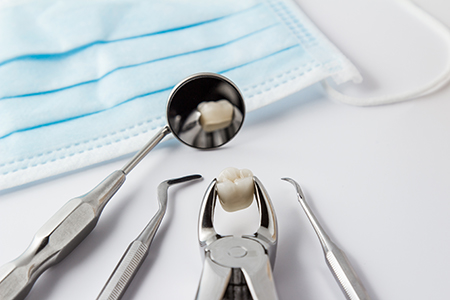
When a tooth is removed, many patients are understandably curious about replacement options. Restoring the space left by an extracted tooth can protect adjacent teeth, preserve chewing efficiency, and maintain facial structure. Common restorative paths include removable dentures, fixed dental bridges, and dental implants. Each option has advantages depending on the location of the missing tooth, bone health, and the patient's overall goals.
Dental implants are the most stable long-term solution for replacing single teeth or anchoring fixed restorations because they integrate with the jawbone and can preserve bone levels. Bridges provide a reliable, non-removable option when adjacent teeth are healthy enough to support the restoration, while dentures remain a versatile solution for multiple missing teeth. We will review the pros and cons of each option in the context of your oral health and lifestyle.
Choosing the right restorative path is a collaborative process. We consider the condition of neighboring teeth and gums, bone availability, and your priorities for function and appearance. If additional procedures are needed—such as bone grafting or sinus augmentation—to support the chosen restoration, we will explain why these steps are recommended and how they fit into the overall timeline.
Our practice emphasizes careful assessment, clear explanations, and gentle technique to make extractions as predictable and comfortable as possible. From initial consultation through follow-up care, we coordinate treatment with an eye toward long-term oral health and restoring function where needed. Morris Center for Dentistry places a high value on patient education so you understand not just what we are doing, but why.
When a tooth must be removed, you can expect a treatment plan that fits your needs and a team that supports you at every step. We take time to answer questions, discuss all reasonable options, and provide precise post-operative guidance so healing proceeds smoothly and complications are minimized.
Whether the extraction is part of emergency care, orthodontic preparation, or a longer restorative plan, we work to ensure the experience is respectful, safe, and aligned with your goals for a healthy smile.
If you have additional questions about tooth extractions, recovery, or replacement options, please contact us for more information or to schedule a consultation.


The most common reasons for tooth loss include advanced periodontal disease, extensive tooth decay, and facial trauma. According to statistics, gum disease is responsible for close to 70% of tooth loss in adults. Although less frequent than the preceding three reasons, it should also be noted that specific diseases, drugs, smoking, and poor nutrition contribute to the risk of tooth loss.
The Centers for Disease Control and Prevention report that in the United States, an average of 12 teeth (including the wisdom teeth) are lost by the age of 50. Also, 26% of adults between 65 and 74 years of age have lost all their teeth.
Every patient and every situation is different. However, when a tooth and the surrounding tissues are numbed with a local anesthetic, you should only expect to feel a bit of pressure, but no pain as the tooth is being loosened from the surrounding tissues and extracted. For patients who are apprehensive and for some surgical extractions, our office will discuss our options in dental sedation to provide further relaxation and reduce any sense of discomfort.
While it's normal to feel some tenderness and swelling following an extraction, the degree of these sensations can vary. It mostly depends on the complexity of the extraction and the body's response to the procedure. We'll recommend or prescribe the appropriate pain medication to help ensure your comfort and give you specific instructions for maximum effectiveness and safety.
Typically, the recovery period following a simple extraction is shorter than a surgical extraction. However, a patient's overall health, habits, the size and location of the tooth, and other variables can influence recovery and healing. To speed up the recovery and avoid any complications, patients must follow the given at-home instructions diligently. We'll carefully review what to expect following your procedure and go over your post-op instructions.
Smoking interferes with blood clot formation, which is an essential first step in the healing process. Blood clot formation not only provides a protective layer to cover the underlying exposed bone and nerve endings, but it also supports the growth of new tissue. Cigarette smoke also contains chemical toxins that can disrupt the healing process and lead to problems such as continued inflammation, infection, or dry socket.
In a very small percentage of cases, a condition known as dry socket can develop in the aftermath of a dental extraction. This painful condition can arise when the blood clot in the extraction site doesn't form properly or gets dislodged. With dry socket, you may experience throbbing pain and symptoms such as bad breath and an unpleasant taste in your mouth. As skilled providers of care, our office will provide immediate treatment to alleviate your discomfort and promote healing.
The last teeth in your mouth to develop, wisdom teeth often do not have enough room to fully erupt or may be positioned in the wrong direction. These issues can affect your dental health as well as overall wellbeing. While some individuals never develop all their wisdom teeth, and a few have sufficient space for them, there are many people with partially or fully impacted third molars. Our office will monitor the development, position, and health of your wisdom teeth and will advise you if and when extractions are indicated.
After a tooth is removed, bone-grafting material is sometimes placed in the socket to promote healing and encourage new bone development. This procedure is often performed to support the eventual and successful placement of a dental implant.
At the office of Morris Center for Dentistry, we strive to make dental care affordable and accessible. Depending on the type or complexity of the extraction and other variables, the cost of the procedure can vary. Based on our diagnostic findings, our office will inform you of the healthiest choices in care, explain the fees, discuss insurance coverage, and explain your payment options.
Many dental plans offer some level of coverage for tooth extractions. We'll advise you if your plan covers the full cost of the procedure and if there is any out-of-pocket expense. Our business office will work with you to maximize your insurance benefits as much as possible while helping you minimize any out-of-pocket expenses.

Dr. Theodore Morris and Dr. Janet Mangum bring decades of combined experience to every patient who walks through our doors, no matter what brings you in.
We know life is busy, so our Mint Hill team works hard to make dental care simple - offering flexible scheduling, a warm and welcoming office, and treatment plans tailored to your needs and your budget. Give us a call at (704) 545-3363 or request an appointment online, and let us help you and your family enjoy healthier, more confident smiles.

Back to top